
Finding an activity suitable for a four-year-old, a teenager, and a grandparent in the same afternoon often feels like a puzzle. The usual reflex is to look for a soft compromise where no one is really bored, but where no one is really having fun either. However, leisure formats have evolved in recent years, and some deserve attention because they solve this problem differently.
Cooperative intergenerational activities: going beyond mere co-presence
Bringing together three generations in the same place is not enough to create a shared activity. Sitting a child and their grandparent side by side in front of a show is co-presence, not cooperation.
The formats that work best assign a common goal with roles suited to each age. A collective cooking workshop, for example, allows the youngest to mix, the teenager to manage the cooking, and the oldest to bring technical know-how. Everyone genuinely contributes to the final result.
Have you ever noticed that a cooperative board game captures attention more than a competitive game when the skill levels are very different? It’s the same principle. Real cooperation maintains the engagement of each participant, because the outcome depends on everyone. This trend towards activities where participants of different ages pursue a common goal with adjustable difficulty levels is increasingly documented in the leisure sector.
To explore concrete ideas, leisure activities on MaxiScoop gather ideas categorized by type and audience, making it easier to search when planning a weekend with extended family.

Family escape room: adapting difficulty without diluting the challenge
The escape room has become a classic family outing, but not all formats are equal when mixing ages. A scenario designed for adults, simply open to children from eight years old, often leads to frustration. The child watches, the adult solves.
The best family escape rooms offer puzzles with multiple entry points. Specifically, the same puzzle can be approached through physical manipulation (suitable for younger ones), logic (for teens), or general knowledge (for adults). Each person unlocks part of the solution.
At-home escape room kits
Before booking a room, testing a kit at home allows you to gauge everyone’s interest. These kits cost significantly less than a session in a room and can be played at your own pace. Some are designed for children as young as six, with visual clues that do not require fluent reading skills.
The advantage of the home format: you can pause the game, snack, and resume. With young children, the flexibility of pace is as important as the quality of the scenario.
Inclusive leisure: what accessibility changes for everyone
Accessibility in leisure activities is not just about people with disabilities. When a venue adapts its pathways for visitors with reduced mobility, it also simplifies the visit for strollers, elderly people, or large families carrying equipment.
In France, less than 5% of children with disabilities are welcomed in leisure centers, according to feedback shared by La Voix du Nord in September 2026. This figure highlights the gap between supply and needs.
Reverse inclusion, a still rare format
The association Les Bobos à la ferme experimented in 2025 with a format called “reverse inclusion”: weeks of care designed primarily for children with disabilities or illnesses, which also include children without disabilities. The idea is no longer to adapt an existing activity marginally, but to start from specific needs to build the program.
This type of format remains marginal, but it illustrates an evolution in thinking about shared leisure. Designing for the most constrained often benefits the largest number.
Treasure hunts and water games: classics as long as they are renewed
The treasure hunt has been working for generations, but the format “hidden paper clues in the garden” quickly bores teenagers. A few adjustments can rekindle interest:
- Integrate physical challenges between clues (obstacle courses, tug-of-war) to vary the pace and involve more athletic profiles.
- Add a credible narrative thread: a story to solve, not just clues to collect. Children from five years old engage better when a character is involved.
- Delegate the organization to teenagers. Designing a treasure hunt for younger ones gives them a valuable role and engages their creativity.
For water games in summer, the principle is the same: involving each age group in the preparation transforms the game into a collective project. Filling balloons, setting up a course, defining the rules. The activity starts well before the kickoff.
At-home activities that don’t feel like babysitting
Rainy days or long vacations push us to seek indoor activities. The classic trap: offering coloring to the little ones and leaving the teens on their screens.
Some formats work better than others for genuinely engaging a mixed-age group:
- The short board game tournament (games lasting ten to fifteen minutes) with a ranking for the day. Simple rules allow younger ones to participate, and the tournament format motivates teens.
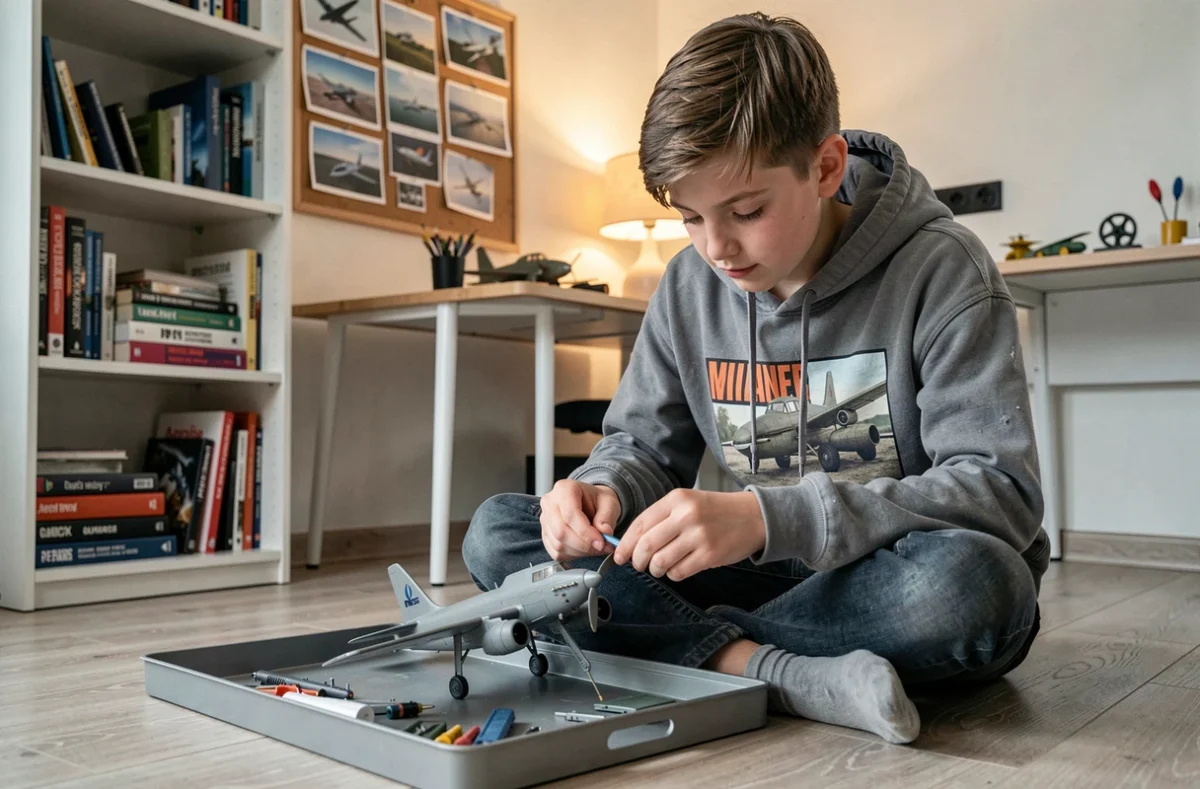
- The DIY workshop with a useful goal: making a birdhouse, customizing a piece of furniture, repairing an item. The tangible result gives meaning to the effort.
- The cooking session with a set theme (an ingredient, a color, a country). The creative constraint stimulates more than total freedom.
Why do these formats work better than a simple “do what you want”? Because they combine a clear structure with a margin of freedom within that structure. Children need the framework, teens need the margin.
Choosing a leisure activity for a multigenerational group ultimately comes down to a simple question: does each participant have an active role, or are some spectators? If the answer leans towards the latter option, it often suffices to redistribute the roles rather than change the activity.