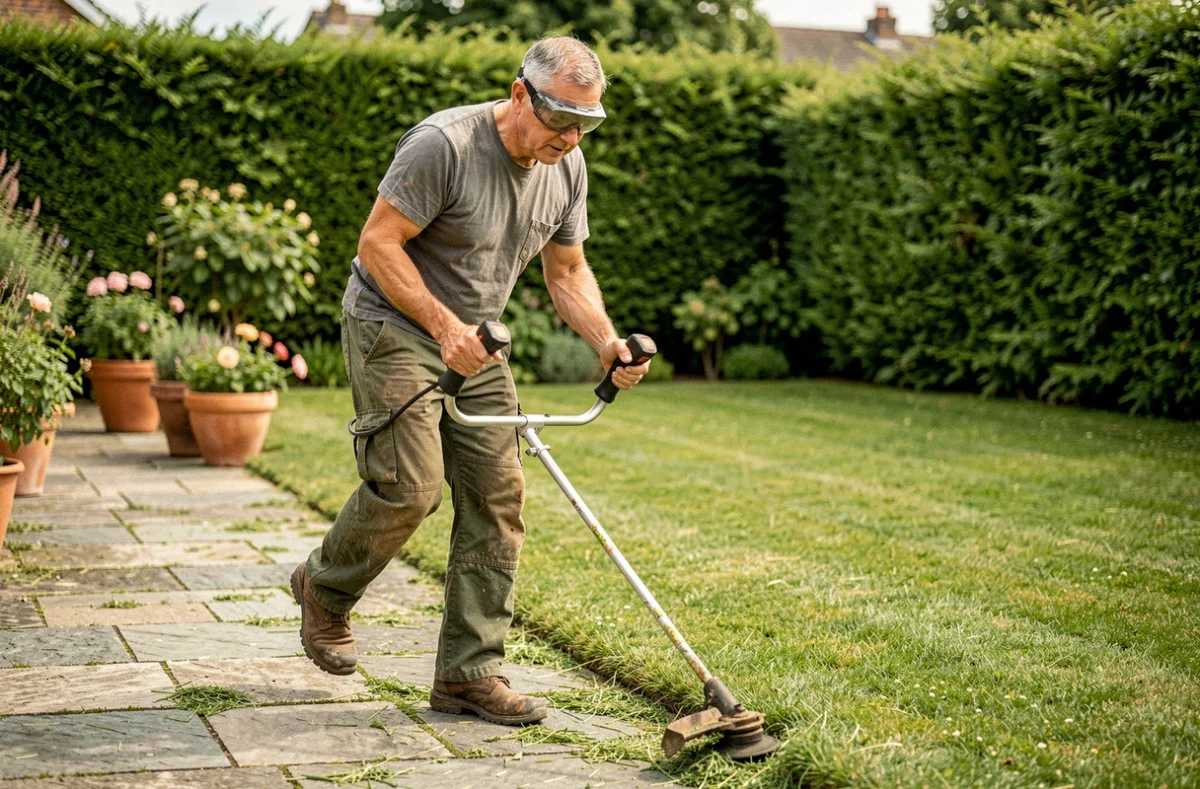
The string trimmer cuts vegetation by the rapid rotation of a nylon line stretched by centrifugal force. Unlike a lawn mower that cuts at a fixed height, the edger works for finishing: it reaches areas inaccessible to traditional blades, along walls, around trees, or between the slabs of a path. Understanding this mechanism changes the way you handle it and, most importantly, the quality of the result on your edges.
Nylon line, blade, or reinforced line: which cutting tool for your edges
The type of cutting tool determines both the visual result and the risk of damaging surrounding surfaces. A standard round nylon line is suitable for soft grass along a lawn. A square or star-shaped line attacks denser and semi-woody grasses better.
A rigid plastic blade, sometimes supplied with battery models, offers a cleaner cut but is less forgiving of trajectory errors against a fence post or trunk. For clean edges without collateral damage, nylon line remains the most versatile choice.
Before each session, check the condition of the line. A line that is too short reduces the cutting diameter and forces you to tilt the machine, creating irregularities. On semi-automatic unwinding models, a tap on the ground releases a few centimeters of new line. Knowing how to use a string trimmer starts with this simple check that avoids most irregular cuts.
Cutting technique with a string trimmer for a regular edge
The precision of an edge depends on three parameters: the angle of the head, the direction of the sweep, and the speed of movement.
Tilting the head to create a clean cutting plane
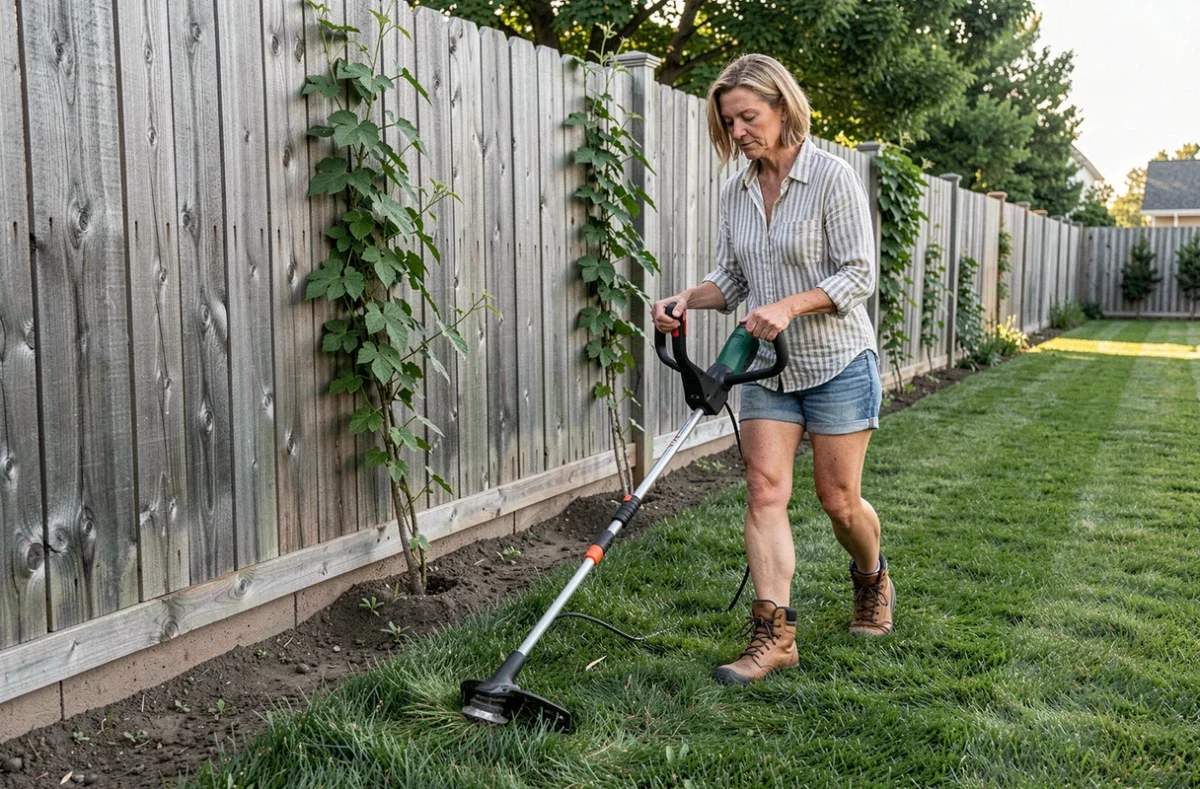
To clearly define a lawn along a path or flower bed, tilt the head of the string trimmer almost vertically (the “edging” function on some models). The line then traces a straight line in the ground rather than a shallow arc. The vertical tilt gives a line comparable to a lawn edger.
Maintain a stable support and progress slowly. A too-quick gesture causes the line to deviate. Aim for a ground marker, a slab, or a concrete edge to guide your trajectory.
Sweeping in the right direction
The line rotates in a specific direction (usually counterclockwise when viewed from above). By sweeping from right to left, debris is thrown towards the already mowed area rather than towards a flower bed or a plastered wall. This detail prevents dirt from getting on surfaces and limits projections towards the face.
Adopt a regular arc movement, without jerks. Each pass should only remove a few centimeters of vegetation. Two light passes produce a cleaner result than a single heavy pass.
Adjusting the harness and handle to reduce fatigue
A poorly adjusted string trimmer tires the back and arms, which degrades cutting regularity after a few minutes. The telescopic handle is adjusted so that the head just grazes the ground without you having to bend your back. Your arms should remain slightly bent, never straight.
On models equipped with a harness (common once the weight exceeds a certain threshold), distribute the load across both shoulders. The harness should bear the weight, not your wrists. Adjust the waist strap so that the head of the edger stabilizes naturally at the desired cutting height.
- Adjust the handle to your height before starting, not during work, to avoid losing the cutting line.
- Position the auxiliary handle so you can pivot your wrist effortlessly, which controls the angle of the head.
- If the model has an adjustable guard, orient it to protect your legs from projections while maintaining visibility of the cutting area.
Edges and biodiversity: adapting the cutting frequency of the string trimmer
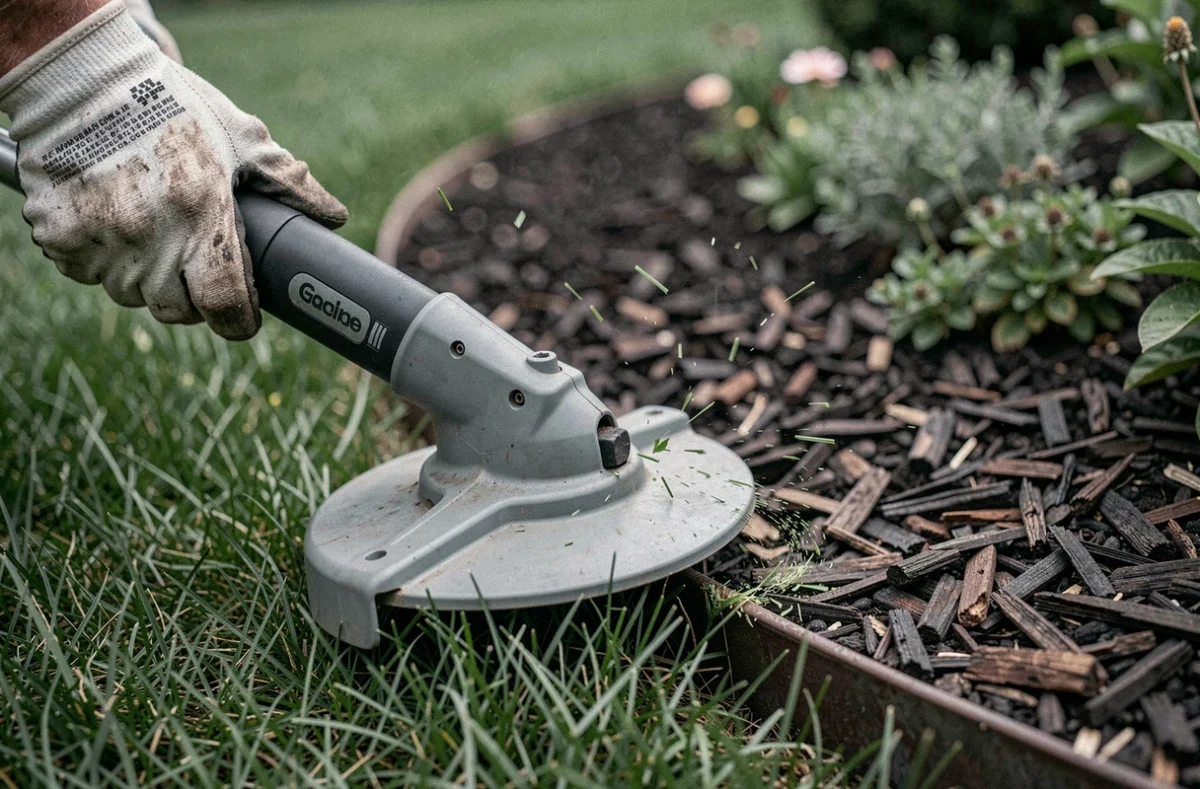
Maintaining a neat edge does not mean shaving all surrounding vegetation every week. Differentiated mowing involves keeping a short and clear strip along the lawn while leaving a taller area a few meters away. The string trimmer is then used to trace this visual transition, not to uniform the entire garden.
During the breeding periods of small wildlife (spring and early summer), spacing out passes in less frequented areas of the garden reduces disturbance. The Naturalist Group of the University of Montpellier recommends avoiding maintenance operations during these sensitive periods and advocates maintaining refuge strips.
In practice, a pass every two to three weeks on the main edges is sufficient to keep a neat appearance. Secondary edges (back of the garden, around a composter) can be treated once a month without compromising the overall aesthetics.
Protective equipment and noise regulations
The rotating line projects stones, wood fragments, and insects at high speed. Always wear closed protective glasses, long pants, and sturdy shoes. Earplugs or a noise-canceling headset are recommended as soon as the session exceeds a few minutes, especially with a gas model.
- Glasses or full-face shield: protect against direct projections to the eyes.
- Thick pants or leg guards: the line can whip the skin at close range.
- Hearing protection: a gas string trimmer generates a noise level that can become harmful with prolonged use.
Regarding regulations, the allowed usage times vary from one municipality to another. Municipal or prefectural decrees set the authorized hours for powered gardening equipment. Even within an authorized time slot, noise deemed excessive due to its duration or repetition can constitute a nuisance to neighbors. Battery models, which are significantly quieter, offer more flexibility in scheduling without the risk of complaints.
A well-adjusted string trimmer, held at the right height and used with an appropriate line, transforms a rough finish into a clean edge. The technique refines over a few sessions. The only lasting trap remains haste: two slow passes are always better than a single quick pass.