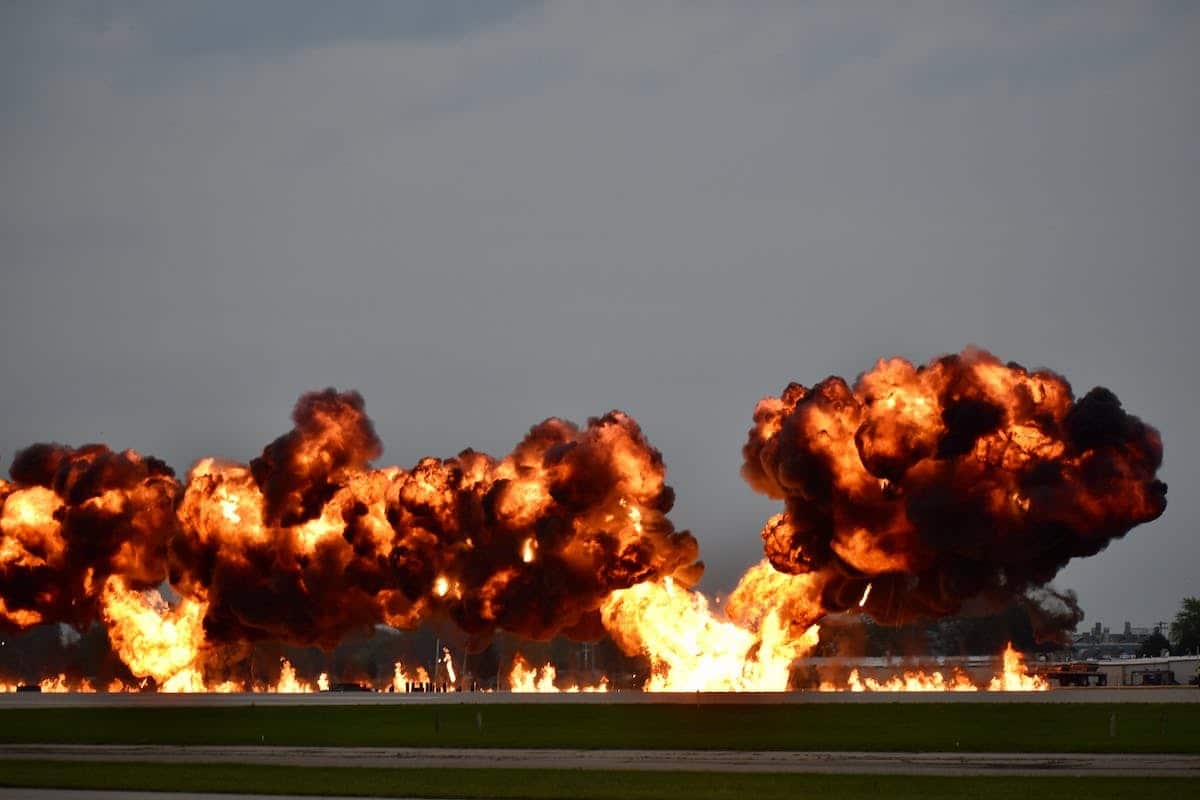
The origin of napalm, an incendiary weapon that transformed the nature of warfare, is rarely discussed. Its history is epic yet little known, marked by scientific advancements, controversial political decisions, and devastating consequences. First used in the deadliest conflict of the 20th century, napalm became a weapon of choice for military forces around the world. This viscous substance that adheres to the skin and burns at extremely high temperatures has sparked fierce criticism and has been at the center of many debates on international humanitarian law.
Birth of the incendiary weapon: a burning past
The history of Greek fire is closely linked to that of incendiary weapons, including napalm. At the heart of the Byzantine Empire, around 672 AD, military engineers developed this devastating weapon to withstand the Arab-Muslim assaults threatening Constantinople. Its application was primarily maritime, using bronze tubes mounted on ships or from the city walls.
This flaming substance was mainly composed of crude oil • found in certain regions of Asia Minor and Crimea • mixed with various other secret components. The uniqueness of Greek fire lies in its extreme adhesiveness: it stuck to skin and materials while continuing to burn, even underwater. This echoes with modern napalm, which has a similar characteristic.
Greek fire thus allowed the Byzantines to effectively repel their adversaries for nearly a thousand years until its recipe was lost during the sack of Constantinople in 1204 during the Fourth Crusade.
Over time and under different chemical formulas, it can be said that the fundamental principle of Greek fire endured until it became usable by aircraft during World War II with what is now called ‘napalm’. The name comes from the two key ingredients used in its creation: naphthenate aluminum and palmitate aluminum.
The history of Greek fire is thus, in a way, the preface to that of napalm. These two incendiary weapons each marked their time with their devastating power, altering military strategies and changing the course of the conflicts in which they were used.
Napalm: the rapid evolution of a destructive weapon
The development of napalm saw a rapid progression after World War II. Technological advancements and the experience gained on the battlefields allowed for improvements in its composition and effectiveness.
In the 1940s, the U.S. government became highly interested in this incendiary weapon due to its promising results in previous conflicts. Researchers undertook numerous experiments to develop an even more formidable napalm.
Thanks to advances in chemistry, new gelling agents were introduced to increase napalm’s adherence to targeted areas. Specific additives were incorporated to raise the combustion temperature and intensify the devastating flames produced by this incendiary agent.
The massive use of napalm during the Vietnam War sparked intense controversy within the international community. Indeed, the horrific images showing burning Vietnamese villages shocked the entire world. This intensive use also raised ethical questions regarding the employment of such a destructive weapon against civilian populations.
This landmark event led to a collective awareness regarding the use of incendiary weapons. International treaties such as Additional Protocol III to the Geneva Conventions now prohibit their use against civilians or in populated areas.
Since then, napalm has primarily been used in military contexts to destroy structures and eliminate enemy shelters. Countries that possess it continue to use it strategically, although its use is now governed by strictly defined rules.
The history of napalm reflects a constant evolution aimed at improving its destructive capabilities. Its development has been marked by an incessant search for more effective means to inflict significant damage on opposing forces. The global awareness of the catastrophic consequences it can cause has led to a strict regulation regarding its use. While napalm remains a particularly fearsome weapon, its scope is now limited by a restrictive and moralizing international legal framework.
Napalm: the chaos it sowed in conflicts
The use of napalm in conflicts has had a major impact on how armies conduct their operations. Its ability to cause massive fires and inflict atrocious injuries has made napalm a formidable weapon, capable of instilling terror among enemy forces.
During the Vietnam War, napalm was widely used by the U.S. military to destroy weapons caches and fortified enemy positions. Aircraft flew over targeted areas and dropped canisters filled with this dangerous flammable cocktail. Upon impact, the gel transformed into an infernal fireball that engulfed everything in its path. The sticky flames clung to human bodies, burning skin down to the bone.
The intensive use of napalm during this period deeply marked the collective imagination and helped galvanize the anti-war movement. The shocking images broadcast in the media sparked a wave of international outrage. The world was horrified to discover the cruelty that this insidious weapon could unleash.
It would be reductive to claim that the only impact of napalm was negative. In some cases, its use may have allowed for quicker resolutions to certain conflicts by significantly weakening the adversary or forcing its surrender.
Napalm: controversies and heated discussions
The destructive nature of napalm has sparked intense debates and controversies throughout history. Many countries have been questioned about its legitimacy and use in wartime. Some view it as a blatant violation of human rights, while others believe it is necessary in certain contexts to ensure national security.
One of the main criticisms of napalm concerns its indiscriminate nature. Indeed, when used, it makes no distinction between enemy combatants and innocent civilians. The tragic consequences are then inevitable: innocent victims find themselves trapped in a burning hell, suffering unbearable pain.
Some worry that napalm causes injuries that go beyond immediate death. Survivors often face significant physical and psychological scars that can have a lasting impact on their daily lives.
Proponents of napalm argue that it is an effective weapon for quickly neutralizing enemy forces entrenched or hidden in densely populated urban areas. They also claim it can help reduce the overall duration of a conflict by quickly inflicting a high level of destruction on enemy infrastructure.
These arguments do not escape criticism, which points out that the massive use of napalm promotes a brutal and uncontrollable escalation of hostilities. Some believe that the disastrous humanitarian consequences that result can damage the image and reputation of countries using this weapon.
In light of the ethical and moral debates surrounding napalm, several initiatives have been taken to restrict its use. International treaties such as Protocol III of the Convention on Certain Conventional Weapons specifically prohibit incendiary canisters containing napalm when used in populated civilian areas.
Overall, it is undeniable that napalm has profoundly marked military history and sparked intense controversies. Its use continues to fuel discussions on the morality and legitimacy of incendiary weapons in modern conflicts. It is therefore up to us, as a society, to continue these crucial debates to find a balance between national security and respect for fundamental human rights.
Napalm: when its use becomes prohibited
The ban on napalm was the result of a long diplomatic process and international mobilization. The first formal restrictions emerged in the 1970s, with the adoption of Protocol III of the Convention on Certain Conventional Weapons. This protocol prohibited the use of incendiary canisters containing napalm in densely populated civilian areas.
Despite these legislative advances, some countries continued to use this incendiary weapon in a roundabout way or by developing more sophisticated variants. These actions sparked a growing international reaction and a call for a total ban on napalm.
In 1980, a significant milestone was reached with the adoption by the United Nations of a resolution calling for a moratorium on the use of napalm until stricter regulations could be established. This resolution marked the international recognition of the inherent dangers of napalm and the willingness to find alternatives to minimize its devastating consequences.
Since then, several international treaties and conventions have followed to strengthen restrictions on napalm. In 1997, the Convention on the Prohibition or Restriction of the Use of Certain Conventional Weapons (CCW) also added measures aimed at limiting its misuse.
Despite this, it should be noted that some countries have not ratified these agreements or do not fully comply with their commitments. Reports persist of the use of napalm in some recent conflicts, raising concerns about the need for more rigorous monitoring and enforcement.
The total ban on napalm remains an objective to be achieved, in order to ensure maximum protection for innocent civilians caught in armed conflicts. This requires ongoing international cooperation and political will to enforce established humanitarian standards.
The history of napalm is marked by its devastating effects on a human level and its impact on military strategies. Despite legislative advances aimed at limiting its use, significant challenges remain to definitively end this incendiary weapon. The preservation of national security and respect for human rights must be constantly considered in these complex debates surrounding the regulation of incendiary weapons.
Napalm: a burning legacy with lasting consequences
The tumultuous history of napalm has left an indelible legacy, with current consequences that continue to weigh on the populations affected by this vile weapon. The long-term effects on the environment and human health are profound, marking the grim impact of napalm.
On the environmental front, areas bombed with napalm have often been reduced to ashes, causing unprecedented devastation. Lush forests turn into barren lunar landscapes where little life remains. Biodiversity is annihilated, and it takes decades for nature to laboriously attempt to regenerate.
On the human side, victims directly exposed to napalm suffer intense pain from the chemical burns it inflicts. Survivors may be physically scarred for life, with horrific scars that remind them of their terrible encounter with this insidious weapon.